Trading Card Grading & Submission Guide
Compare top grading companies, master 60/40 pre-grading inspection, calculate ROI, and learn how to safely package your cards.
Top 6 Professional Grading Agencies
Flip through the major card grading brands active globally. Compare authentic slab aesthetics, grading specialties, and official portal links:
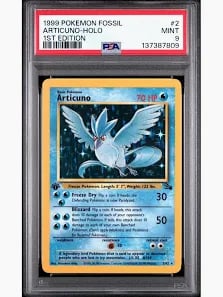
PSA (Professional Sports Authenticator)
United States (Global)The absolute market leader in sports and trading cards. PSA grading holds the highest resale premium in the secondary market.
Pricing & Turnaround Times
Approximate per-card costs and estimated turnaround times by service tier. Prices shift frequently — always verify on each agency's official submission page before sending.
Full Grading Scale Translation Matrix
Every numeric grade maps to a named condition. Use this table to translate what a PSA 7, BGS 8.5, or CGC 9 actually means.
| Grade | PSA | BGS | CGC |
|---|---|---|---|
| 10 | Gem Mint | Pristine / Black Label | Pristine |
| 9.5 | — | Gem Mint 9.5 | Near Mint/Mint+ |
| 9 | Mint | Mint 9 | Near Mint/Mint |
| 8.5 | — | NM-Mint+ 8.5 | — |
| 8 | Near Mint-Mint | Near Mint-Mint 8 | Near Mint |
| 7 | Near Mint | Near Mint 7 | Fine/Very Fine |
| 6 | Excellent-Mint | Excellent-Mint 6 | Fine |
| 5 | Excellent | Excellent 5 | Very Good/Fine |
| 4 | Very Good-Excellent | VG-Excellent 4 | Very Good/Excellent |
| 3 | Very Good | Very Good 3 | Good/Very Good |
| 2 | Good | Good 2 | Good |
| 1 | Poor / Fair | Poor 1 | Poor |
Buying Graded Cards: What to Look For
Not everyone submits their own cards — many collectors buy pre-graded slabs. Here's how to verify authenticity and avoid tampered or fake slabs before handing over your money.
Verify Slab Authenticity
- ✓Look up the cert number on the grading company's official website (PSA, BGS, and CGC all have free cert lookup tools). Confirm the card name, year, set, and grade all match what you're buying.
- ✓Scan the QR code or barcode on modern slabs with your phone to confirm it links directly to the official registry entry.
- ✓Inspect label security features under bright light. Official labels have fine micro-printing and rainbow holograms. Fakes look flat and slightly blurry.
Red Flags to Avoid
- ✗Seller refuses to share the cert number before purchase — this is an immediate deal-breaker.
- ✗Price is suspiciously below market comps — a PSA 10 Charizard priced 50%+ below eBay sold listings is almost certainly a counterfeit or tampered slab.
- ✗Visible gaps or seam damage along slab edges — the case has likely been cracked and poorly resealed.
Card Grading PSA vs CGC: Which is Better for Your Cards?
The debate between card grading PSA vs CGC is the most common crossroads for modern collectors. Here is how they compare across secondary market value, slab optical quality, turnaround speed, and error cards.
When to Choose PSA
- Highest Resale Value: PSA 10 slabs routinely command a 15% to 30% premium over CGC Gem Mint 10 for modern Pokémon and sports cards.
- Deepest Liquidity: eBay and live card shows see 5x to 10x higher transaction volume for PSA slabs than any other agency.
- Set Registry: PSA's digital Set Registry drives competitive collector bidding on vintage sets.
When to Choose CGC
- Superior Slab Clarity: CGC slabs are engineered with crystal-clear non-frosted acrylic, showcasing card foil texturing far better than PSA.
- Pristine 10 Gold Label: CGC Pristine 10 cards sell at parity with PSA 10 and Beckett BGS 9.5/10.
- The Leader in Error Cards: CGC is the undisputed gold standard for miscuts, double prints, ink errors, and factory crimps.
- Fast, Reliable Turnarounds: Noticeably shorter queue times on bulk and economy submission tiers.
CGC Cards Turnaround Times & Submission Tiers
Track official estimated turnaround times for CGC Cards submissions. CGC measures turnaround times in working business days after receipt and opening at their Sarasota, Florida facility.
| CGC Tier | Estimated Turnaround | Cost / Card | Max Declared Value | Ideal Candidates |
|---|---|---|---|---|
| Bulk (25+ Cards) | 35 – 45 Working Days | $12 – $14 | $250 / card | Modern holos, binder staples, low-dollar raw singles |
| Economy | 20 – 25 Working Days | $15 – $18 | $500 / card | Chase cards ($100–$400 raw), mid-tier vintage |
| Standard | 15 – 20 Working Days | $35 – $40 | $1,000 / card | High-end secret rares, vintage holos, serialized cards |
| Express | 5 – 7 Working Days | $75 | $10,000 / card | High-value grails, urgent tournament/auction prep |
| Walk-Through | 2 – 3 Working Days | $150 + 1% value | Unlimited | Five-figure museum grails (Base Charizard, Black Lotus) |
Baseball Card Grading System: Standards Across Eras
The baseball card grading system differs substantially from trading card games like Pokémon or Magic due to different paper stocks, waxing techniques, and cutting machinery across historic eras.
Vintage Baseball (Pre-1980)
Vintage cards (such as 1952 Topps Mickey Mantle or 1968 Nolan Ryan) were printed on rough cardboard stock with wax pack stains and hand-cut blades. Graders allow 70/30 centering for PSA 7 and prioritize overall eye appeal. Collectors heavily favor SGC's Tuxedo slab and PSA for vintage baseball.
Junk Wax Era (1986–1993)
Due to astronomical print volumes, cards from the Junk Wax era (1989 Upper Deck Ken Griffey Jr., 1986 Donruss) only hold serious financial value in PSA 10 Gem Mint. A PSA 9 often sells for less than the submission fee, making 60/40 pre-grading centering checks critical.
Modern Chrome & Autographs
Modern baseball cards (Bowman Chrome 1st autographs, Topps Chrome refractor parallels) feature thick cardstock and on-card blue ink autographs. Graders evaluate both the physical card condition (1-10) and assign a separate Autograph Grade (Auto 10) based on ink streaking or edge clipping.